Health TechHealth Tech in 2026: AI Wearables and Remote Care
By the CalcCafe editorial team · Published 15 June 2026 · runs 100% in your browser
Health technology in 2026 has quietly crossed a line: the kind of AI pattern-recognition that once lived inside hospital equipment now sits on your finger, your wrist, and your bathroom scale. Here's what's actually changing, and how to make sense of your own numbers.
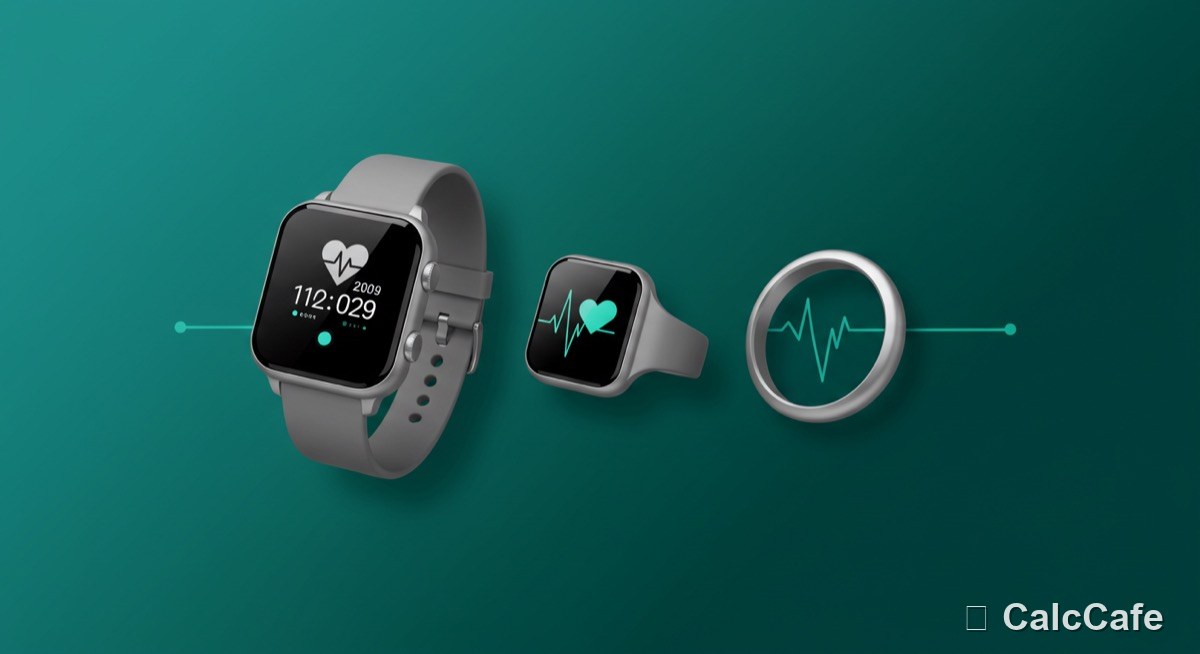
For most of the past decade, wearables counted steps and estimated calories. In 2026, they do something far more interesting: they look for patterns a human might miss. The center of gravity in health tech has shifted from tracking to interpreting — and from the clinic to the everyday device you already wear.
From hospital equipment to everyday devices
The defining trend of 2026 is that AI diagnostics have left the building. Capabilities that used to require a cardiology lab are now embedded in consumer hardware: smart rings, smart scales, and blood-pressure watches running health AI models directly on the device.
Modern wearables can now flag a surprising range of early signals from continuous data, including:
- Arrhythmia risk — irregular rhythms such as atrial fibrillation, detected from optical and ECG sensors, with several smartwatches now carrying regulatory clearance for AF notifications.
- Sleep apnea signs — breathing disruptions inferred overnight; pooled research on wearable AI reports high sensitivity for screening, though confirmation still needs a clinical test.
- Early heart-failure clues — subtle drifts in heart-rate-variability trends that can precede symptoms by days.
The hardware caught up, too. At CES 2026, Dreame debuted an AI-driven health ecosystem built around three smart rings and a blood-pressure watch — including an ECG ring with a remote "Family Care" feature and a watch using on-device health algorithms for medical-grade readings. The headline detail wasn't any single sensor; it was that the AI models run on the device itself, an approach echoed across the multimodal wearable ecosystems on show.
The shift to continuous, preventive smart care
Older health data was a snapshot: one blood-pressure reading at an annual checkup. The 2026 model is a continuous stream. That changes what's possible, because most chronic conditions announce themselves through trends, not single measurements.
This is where remote patient monitoring (RPM) has matured. Instead of waiting for a patient to feel unwell, predictive algorithms watch the incoming data and surface concerns early. In several studies of heart-failure and COPD programs, RPM paired with predictive alerts has been associated with 20–50% reductions in 30-day readmissions — a meaningful dent in one of healthcare's most stubborn and expensive problems.
The quotable shift: care is moving from reactive and episodic to continuous and preventive. Your data no longer sleeps between appointments.
AI augments clinicians — it doesn't replace them
It's easy to read "AI diagnostics" and imagine an algorithm replacing your doctor. The reality on the ground in 2026 is more grounded, and more useful: AI is decision support.
A wearable that flags a possible arrhythmia isn't diagnosing you — it's raising a hand so a clinician can look. The algorithm is good at one thing humans struggle with: tirelessly scanning weeks of continuous signal for faint patterns. The clinician brings context, judgment, and the full picture of your history. The best outcomes come from pairing pattern-recognition with human expertise, not choosing between them.
Your data, your privacy
Continuous health monitoring creates a continuous health record — one of the most sensitive datasets about you that exists. As more intelligence moves on-device, a genuine privacy advantage emerges: sensitive computation can happen locally, without streaming every heartbeat to a server.
That principle is worth carrying into the rest of your health toolkit. Before you trust any tool with personal numbers, it's fair to ask a simple question: does this data need to leave my device at all? Often, the answer is no.
Put your own numbers to work
Wearables are excellent at gathering data. But raw data isn't insight — you still need to interpret the baseline numbers that give all those trends meaning. That's where a few simple, well-understood calculations come in, and you don't need an account or a cloud upload to run them.
CalcCafe's health calculators run entirely in your browser, so nothing you type ever leaves your device — the same privacy-first principle driving on-device wearable AI:
- Start with the BMI Calculator to get a quick, standardized read on weight relative to height — a common starting reference point clinicians use.
- Use the BMR Calculator to estimate the energy your body burns at rest, the foundation your wearable's "active calories" build on top of.
- Try the Body Fat Calculator for a composition estimate that adds nuance BMI alone can miss.
- Bring it together with the Calorie Calculator to translate your goals into a daily target you can actually track.
Think of it as a two-layer system: your wearable supplies the live signal, and these free in-browser tools give you the stable baseline numbers to interpret it against.
What to watch next
The trajectory is clear. Sensors are getting smaller and more capable, AI models are moving on-device, and remote monitoring is shifting from a niche program to a default expectation for chronic care. The winners won't be the flashiest gadgets — they'll be the systems that combine accurate sensing, transparent AI, real clinician involvement, and respect for who owns the data.
Not medical advice. Wearables and online calculators are tools for awareness and education, not diagnosis. They can miss things and they can raise false alarms. For any symptom, concerning reading, or decision about your health, talk to a qualified healthcare professional.
Frequently asked questions
Can a smartwatch or smart ring actually diagnose a heart condition?
No. Consumer wearables can flag possible signals — like an irregular rhythm or signs of sleep apnea — and some carry regulatory clearance for specific notifications. But flagging is not diagnosing. A confirmed diagnosis requires a clinician and usually a dedicated medical test. Treat wearable alerts as a prompt to seek professional evaluation, not as a verdict.
Does remote patient monitoring really reduce hospital readmissions?
In several studies of heart-failure and COPD programs, remote monitoring combined with predictive algorithms has been associated with roughly 20–50% reductions in 30-day readmissions. Results vary by program design and population, so the figures are encouraging rather than guaranteed, but the direction is consistent: catching trends early helps.
Is on-device health AI better for privacy?
It can be. When AI models run directly on the device, sensitive computation can happen locally instead of streaming all your raw health data to a server. That reduces exposure, though you should still check each product's privacy policy to understand what is stored, shared, or synced to the cloud.
Why use a calculator if my wearable already gives me numbers?
Wearables supply live, continuous signals, but those trends are easier to interpret against stable baseline figures like BMI, BMR, body fat, and daily calorie needs. CalcCafe's calculators compute these entirely in your browser — nothing leaves your device — giving you a private reference layer to make sense of what your wearable reports.
Related calculators
More from the CalcCafe blog